
Hardwood Flooring: What to Know Before You Choose It for Your Home
Love the look of real wood? Here’s what to consider before deciding whether hardwood is right for your home.
If you’re trying to figure out how to choose hardwood flooring for your home, it helps to look beyond color and price. Construction, species, finish, moisture, maintenance, and refinishing all matter.
Hardwood flooring has a look that is difficult to duplicate.
The grain is real. The variation from board to board is real. And over time, the floor develops character in a way manufactured wood-look products do not.
That is a big reason homeowners continue to choose hardwood for living rooms, dining rooms, bedrooms, hallways, staircases, and other areas of the home.
But choosing hardwood flooring involves a lot more than finding a stain color you like.
You also need to think about whether you want solid or engineered wood, which species makes sense for your household, how the floor will react to moisture, how much maintenance you are comfortable with, and whether refinishing later is important to you.
If you are considering hardwood for your home, here are the things worth understanding before you buy.
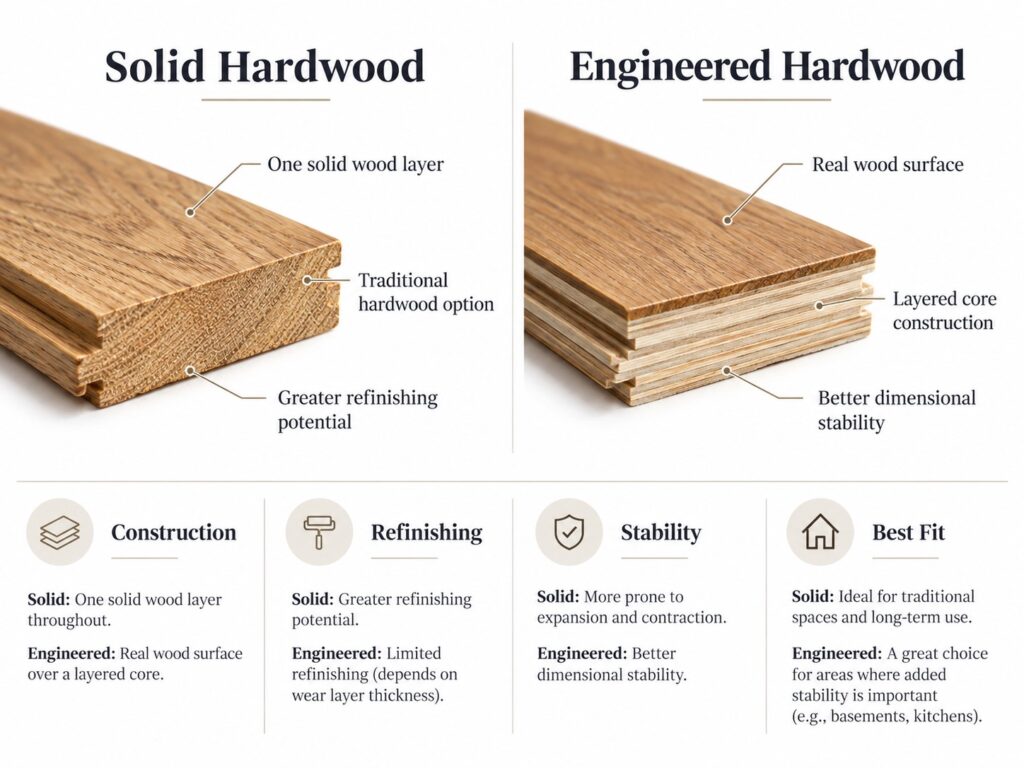
First, What Counts as Real Wood Flooring?
This sounds like a simple question, but flooring terminology can get confusing quickly.
Wood flooring generally refers to flooring with real wood as the top, wearable surface. That includes traditional solid hardwood as well as engineered hardwood flooring.
That distinction matters because laminate and luxury vinyl plank can look remarkably similar to wood, but they are different flooring products.
There is nothing wrong with choosing LVP or laminate when those materials make more sense for your home. The important thing is understanding what you are actually buying.
If you are still comparing wood with vinyl, our Luxury Vinyl Plank Flooring Buying Guide explains the differences in construction, waterproofing, wear layers, and maintenance.
Solid Hardwood vs. Engineered Hardwood
One of the first decisions you may face is whether to choose solid or engineered hardwood.
Both contain real wood, but they are constructed differently.
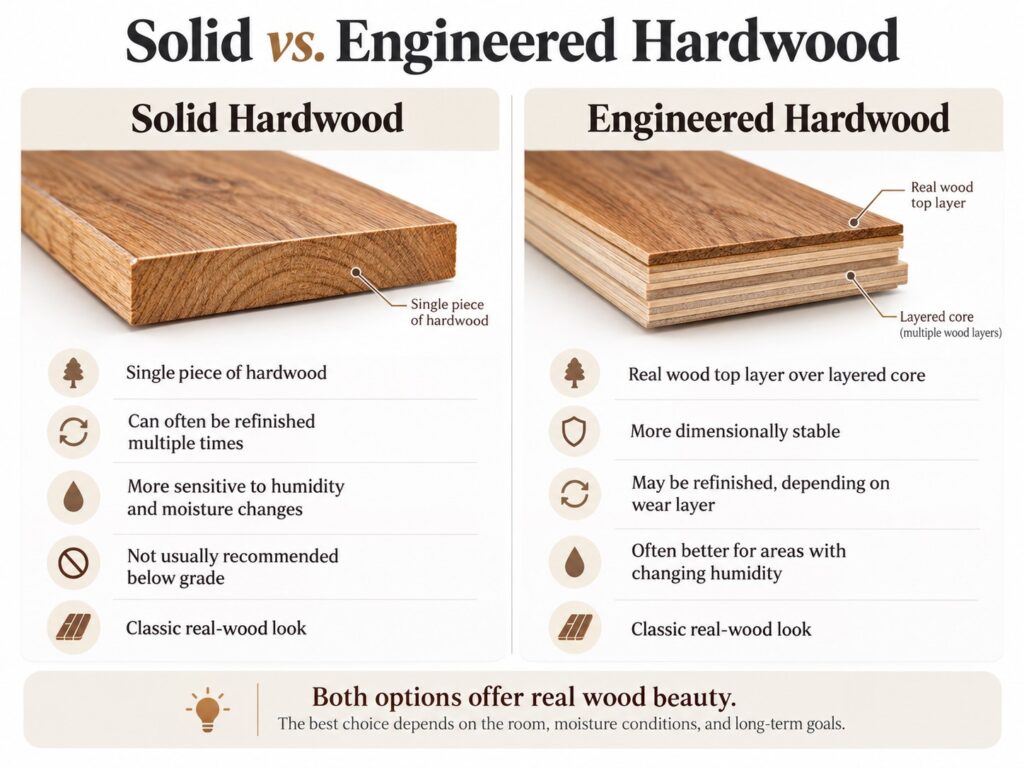
Solid hardwood is made from one piece of wood from top to bottom.
Engineered hardwood uses multiple layers, with real hardwood forming the top visible surface.
That construction gives engineered flooring more dimensional stability. Engineered wood generally expands and contracts less than solid wood as humidity and temperature change and can be used in applications where solid wood may not be appropriate.
Here is the practical difference:
Solid Hardwood | Engineered Hardwood | |
|---|---|---|
Construction | One solid piece of wood | Multiple layers with a real-wood top |
Refinishing | Usually can be refinished multiple times | May be refinished, but generally fewer times |
Moisture movement | More sensitive to environmental changes | Generally more dimensionally stable |
Below-grade installation | Typically not recommended | Often better suited |
Appearance | Real wood | Real wood |
Neither one is automatically better.
The better choice depends on where the floor is going, the subfloor, the product itself, and how important future refinishing is to you.
Don’t Choose Hardwood by Color Alone
Color is usually what catches your attention first.
Warm brown.
Natural oak.
Deep walnut.
Something lighter and more modern.
But color should be only one part of the decision.
Species, finish, sheen, plank width, grade, texture, and construction all affect how the finished floor looks and performs.
Even the width of the boards changes the feel of a room. Narrow strips and wider planks can create noticeably different visual effects.
This is one reason it helps to see a larger flooring sample rather than choosing from a tiny swatch.
A floor can also look very different once it covers an entire room.
Your lighting matters.
Your wall color matters.
Your cabinets and trim matter.
And natural wood contains variation, so you should expect some differences from board to board.
That variation is part of what makes hardwood look like hardwood.
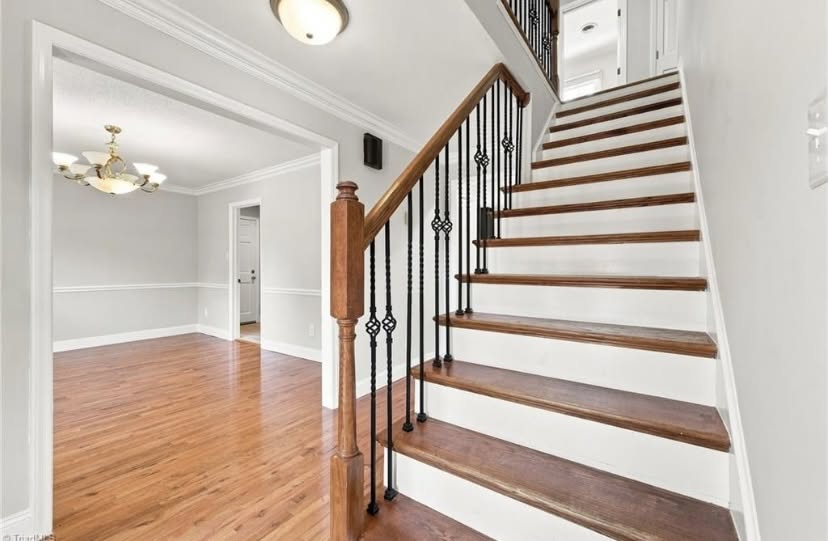
Wood Species Matters, but Hardness Is Not the Whole Story
Different wood species have different levels of hardness.
For solid wood, this is commonly measured using the Janka hardness scale, which measures how much force is required to press a steel ball into the wood.
For example, oak, maple, hickory, walnut, cherry, and birch do not all resist dents in exactly the same way.
But hardness should not be treated as the only measure of durability.
The cut of the wood, the finish, the room, the household, and how the floor is maintained also matter.
In other words:
A higher hardness rating does not automatically mean you have found the perfect floor.
Think about how the room will actually be used.
A quiet bedroom does not experience the same wear as a busy entryway or family room.
The Finish Has a Big Job
The finish is what protects the surface of the wood from everyday wear.
There are several types of hardwood finishes, and they can differ in appearance, durability, drying time, and maintenance requirements.
Some finishes stay clearer, while others add a warmer tone to the wood.
Sheen matters too.
A glossy hardwood floor can look beautiful, but it may make scratches, dust, or everyday wear more noticeable.
Satin and matte finishes can sometimes be more forgiving visually, especially in busy households.
This is another reason not to choose hardwood based entirely on the stain color.
Ask what finish is on the floor too.
Hardwood and Moisture: What Homeowners Should Understand
Wood is a natural material, and natural wood reacts to its environment.
When humidity rises, wood can absorb moisture and expand.
When conditions become dry, wood can release moisture and shrink.
Significant changes in moisture conditions can contribute to problems such as cupping, gaps, or splitting.
Some seasonal movement can be normal.
The goal is to avoid extreme changes and moisture problems.
That is why the conditions inside the home, the subfloor, and the installation environment matter before the first board goes down.
A moisture issue underneath the flooring should not simply be covered and forgotten.
It needs to be identified first.
This is also an area where professional installation becomes important. The correct installation method depends on the particular flooring product, the subfloor, and the room.
Can You Have Hardwood Flooring If You Have Pets?
Yes.
Having a dog or cat does not automatically rule out hardwood flooring.
But you should go into the decision knowing that claws, grit, accidents, and heavy activity can leave marks on real wood.
Species hardness can matter in homes with pets, and keeping pet nails maintained can help reduce damage.
Finish and color can also make a difference.
A floor with natural grain variation and a lower sheen may hide everyday marks better than a very dark, highly polished floor.
Rugs or runners can help in areas where pets run frequently.
And spills or accidents should be cleaned promptly.
If pets are one of your biggest considerations, our Best Flooring for Pets guide compares hardwood with LVP, carpet, tile, and laminate.
One Major Advantage of Hardwood: Refinishing
This is one of the biggest differences between real hardwood and many manufactured flooring products.
When a wood floor begins to look worn, replacement is not always the first answer.
Sometimes a maintenance coat is enough.
In other cases, sanding and refinishing can remove worn finish, scratches, dents, and discoloration and give the floor a dramatically different appearance.
The number of times a wood floor can be sanded depends on several factors, including the thickness of the wear layer, the condition and flatness of the floor, the equipment used, and the person doing the work.
Solid hardwood generally offers more refinishing potential because the wood extends through the entire board.
Engineered hardwood can sometimes be refinished as well, but the number of times depends heavily on the thickness of the real-wood top layer.
That is something worth asking before you buy engineered flooring.
If you expect to stay in your home for many years, refinishing potential can be an important part of the value equation.
What About Everyday Maintenance?
Hardwood does require some care, but the routine itself is fairly straightforward.
The basic goal is to keep abrasive dirt and moisture from sitting on the floor.
Regular sweeping or vacuuming helps remove grit that can scratch the finish.
Spills should be cleaned promptly.
Mats at entrances can help reduce tracked-in dirt.
Felt protectors under furniture can help prevent scratches.
Wet mops and steam mops are generally not recommended for hardwood unless the manufacturer specifically allows them.
It is also a good idea to avoid harsh or abrasive cleaners and to avoid dragging heavy furniture across the floor.
Always follow the care instructions for your specific floor.
Different finishes can have different requirements, and a cleaner that works well on one type of flooring may not be appropriate for another.
That is one reason we recommend keeping the manufacturer’s care and warranty information after installation.
You may need it years later.
The Subfloor and Installation Matter More Than You Can See
Homeowners naturally focus on the finished surface because that is what they will live with every day.
But the floor underneath matters too.
The subfloor needs to be evaluated for things such as moisture, flatness, structural condition, and compatibility with the flooring and installation method.
Solid and engineered hardwood may also have different installation options depending on the product.
That is why two hardwood installation quotes may not always include exactly the same work.
One installer may be accounting for preparation that another quote has not yet addressed.
Before choosing based strictly on price, ask what preparation is included.
Should Indoor Air Quality Be Part of the Conversation?
For homeowners concerned about indoor air quality, it is reasonable to ask about the flooring, finish, adhesive, and other materials used during installation.
Some building materials, adhesives, finishes, and coatings can emit volatile organic compounds, or VOCs.
If this matters to your household, ask about certifications or emissions information for the exact product and installation materials you are considering.
You do not have to become a flooring chemist.
Just ask the question.
Questions to Ask Before Buying Hardwood Flooring
Before making your final choice, make sure you can answer these:
- Is this solid hardwood or engineered hardwood?
- What wood species is it?
- What finish and sheen does it have?
- How durable is the species for the way this room will be used?
- Is the flooring suitable for the room where I want it installed?
- What condition does the subfloor need to be in?
- Are there moisture requirements?
- What installation method does this product require?
- Can this particular floor be refinished later?
- If it is engineered wood, how thick is the real-wood wear layer?
- What cleaning products does the manufacturer recommend?
- What does the warranty cover?
- Is the flooring a practical choice for pets, children, or heavy traffic in my home?
If you know those answers, you are comparing hardwood floors much more intelligently than someone choosing only by stain color and price.
Is Hardwood Flooring Right for Your Home?
Hardwood remains a strong choice for homeowners who want the look and feel of real wood and are comfortable with the maintenance that comes with a natural material.
It can last for many years.
It can often be renewed rather than immediately replaced.
And because every board contains real grain and variation, no two hardwood floors look exactly alike.
But hardwood is not the best solution for every room or every household.
If moisture resistance and very low maintenance are your highest priorities, another flooring material may fit your needs better.
If the warmth, character, longevity, and refinishing potential of real wood matter more to you, hardwood may be worth the extra consideration.
The important part is making the decision with your lifestyle in mind—not simply choosing the floor that looks best in a showroom.
At JAS FloorCoverings & Renovations, we can help you compare hardwood flooring options, look at samples in person, and think through how the flooring will perform in the rooms where you plan to install it.
You can also view our completed flooring projects to see examples of JAS FloorCoverings & Renovations flooring work.