
Best Flooring for Pets: A Practical Guide for Dog and Cat Owners
Choosing flooring with pets? Here’s what to consider before you buy.
If you share your home with a dog or cat, you already know that pets have a way of testing just about every surface in the house.
There are muddy paws after a rainy afternoon. Water splashed around the bowl. Fur that somehow finds its way into every corner. Then there are claws, running, sliding, the occasional accident, and that one favorite spot where your pet seems determined to wear a path into the floor.
That doesn’t mean you need a floor that looks industrial or feels uncomfortable. It does mean you should look beyond color and price when choosing flooring for a home with pets.
The best flooring for pets is usually the flooring that fits your particular pets, your rooms, and the amount of maintenance you’re comfortable with. A quiet indoor cat does not put the same demands on a floor as two large dogs running in and out of the backyard every day.
Here’s what is worth paying attention to before you make a decision.
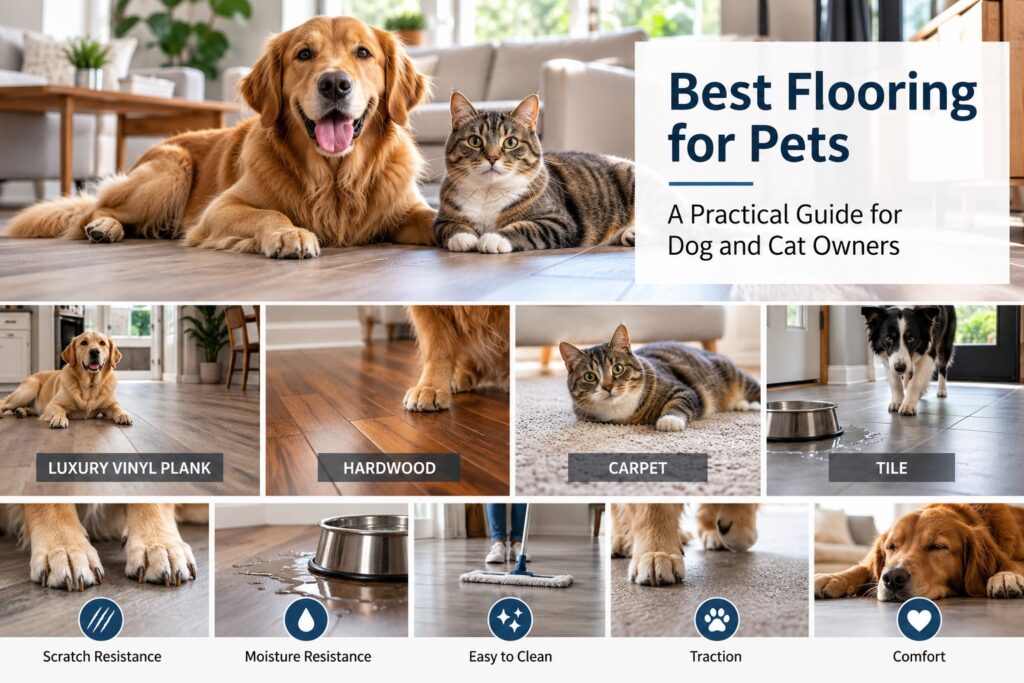
What Actually Makes Flooring Pet-Friendly?
“Pet-friendly” gets used a lot in flooring advertising, but it can mean several different things.
For most homes with dogs or cats, there are five things worth comparing:
- Scratch resistance. Claws, running, furniture movement and grit tracked in from outside can all mark a floor over time.
- Moisture resistance. Think accidents, wet paws and water bowls—not just major spills.
- Ease of cleaning. Pet hair, dirt, dander and the occasional mess are simply part of life with animals.
- Traction. A very smooth surface may be harder for some pets to walk or run across comfortably. Flooring guides aimed at pet owners specifically recommend paying attention to texture and slip resistance.
- Comfort. A hard tile floor and a soft carpet feel very different underfoot, both for people and pets.
You probably won’t find one material that is perfect in every category. The goal is to decide which qualities matter most in your home.
Luxury Vinyl Plank: A Strong All-Around Choice
There’s a reason luxury vinyl plank, or LVP, comes up so often when homeowners ask about pet-friendly flooring.
Many current LVP products are designed to handle moisture well, are straightforward to clean, and offer surface finishes intended to resist everyday wear. Some also have textured surfaces that give pets a little more traction than a very slick finish. Current pet-flooring guidance consistently lists vinyl among the stronger options for households dealing with spills, accidents and regular cleaning.
But there’s an important distinction:
Scratch-resistant does not mean scratch-proof.
Long claws, repeated scratching, dragged furniture and abrasive dirt can still damage vinyl. Even manufacturers that make pet-specific vinyl products talk about increased scratch resistance, not indestructibility. Shaw, for example, currently offers pet-specific luxury vinyl with enhanced scratch protection, while Mohawk sells vinyl collections with separate pet-stain and scratch protections.
That’s why we recommend comparing the actual specifications of the product you’re considering.
Look at the wear layer, finish, core, warranty and installation requirements—not just the sample color.
If you’re already considering LVP, you can also read our Luxury Vinyl Plank Flooring Buying Guide, where we break down wear layers, plank thickness, waterproofing and other specifications to compare before buying.
Luxury Vinyl Plank Flooring Buying Guide
And for information about the flooring itself:
What About Hardwood Flooring With Dogs or Cats?
Having pets does not automatically mean you have to rule out hardwood.
Hardwood still offers something manufactured flooring cannot completely duplicate: it is real wood, and many homeowners simply prefer the look and feel of it.
The tradeoff is that wood is more vulnerable to scratches and moisture than many resilient flooring products. Harder wood species generally tolerate wear better than softer woods, while pet nails and grit can still leave visible marks. Hardwood also needs spills and accidents cleaned up relatively quickly because it is not waterproof. Lowe’s
If you love hardwood and have pets, think beyond species alone.
Finish matters.
Sheen matters.
Color matters.
A highly glossy, very dark floor may make every scratch, speck of dust and light-colored hair easier to notice. A more natural-looking surface with some grain and variation may be more forgiving visually.
Routine pet care helps too. Keeping nails trimmed and using rugs or runners in the most heavily traveled areas can reduce some of the wear.
And unlike LVP, many traditional hardwood floors have another advantage: depending on the construction and condition of the floor, hardwood may be sanded and refinished later in its life. Lowe’s
So the real question isn’t:
“Can I have hardwood if I own a dog?”
It’s:
“Am I comfortable with the maintenance and natural wear that comes with real wood?”
If the answer is yes, hardwood may still be exactly what you want.
Is Carpet a Bad Choice for Pet Owners?
Not necessarily.
Carpet gets dismissed quickly in a lot of pet-flooring articles, but it has advantages that hard flooring doesn’t.
It’s soft.
It’s warm.
It absorbs sound.
And it gives pets much more traction than a slick hard surface. That can be especially useful in rooms where comfort matters.
The downside is maintenance.
Carpet can hold hair and dander, and pet accidents require more attention than they do on a hard surface. The Carpet and Rug Institute recommends more frequent vacuuming in homes with pets, treating fresh accidents promptly, and using cleaners specifically designed for pet stains and odors. It also recommends periodic professional cleaning.
That’s why the type of carpet matters.
Today there are carpets specifically designed around pet stains, spills and easier cleanup. Shaw, for example, currently offers pet-oriented carpet products with stain protection and, on certain styles, backing intended to keep spills from reaching the subfloor.
So instead of asking:
“Is carpet good or bad for pets?”
Ask:
“Which carpet is designed for the way my household actually lives?”
A bedroom in a home with a calm, house-trained dog presents a very different situation from a family room used by several pets throughout the day.
Tile Is Extremely Durable—but There Are Tradeoffs
Tile deserves a place in this conversation because it handles several pet-related concerns very well.
Ceramic and porcelain tile are highly resistant to scratches and moisture, and accidents are generally easy to clean. That can make tile a very practical choice for entryways, kitchens, laundry areas and other spaces that see wet paws and regular messes.
But durability isn’t the only thing that matters.
Tile is hard.
It can feel cold.
And some smooth tile surfaces may be slippery for animals. Pet-oriented flooring guidance suggests looking at slip-resistant options when traction is a concern.
This is a good example of why there really isn’t one universally “best” pet floor.
The flooring that wins on scratch resistance may not win on comfort.
Don’t Ignore Traction
This is one of the most overlooked parts of choosing flooring for pets.
Homeowners understandably think about stains and scratches first. But watch your pet walk across a flooring sample or a smooth floor and you may notice something else.
Some surfaces simply provide more grip than others.
Very smooth finishes can make it easier for paws to slide, while textured surfaces can provide more traction. This is particularly worth considering if your household includes an older pet or one that tends to run through the house.
That doesn’t mean you need rough flooring.
It just means texture is worth including in your decision.
When you’re looking at samples, run your hand across the surface instead of only looking at the color.
Your Pet’s Size and Lifestyle Matter
A flooring decision should reflect how your home is actually used.
Consider two completely different households.
One has an indoor cat that spends most of the day sleeping on the back of the sofa.
The other has two large dogs that go outside several times a day, run through the hallway, splash around their water bowls and come inside with wet paws.
Both homes technically “have pets.”
Their flooring needs are not the same.
Think about:
-
- How large your pets are
- How active they are
- Whether they go outdoors regularly
- Whether accidents are likely
- Which rooms they use most
- How much they shed
- Whether your flooring will be exposed to food and water bowls
- How much cleaning and maintenance you realistically want to do
The answers can quickly narrow down your choices.
Flooring Color Can Make Pet Hair More—or Less—Noticeable
Color gets treated as a design decision, but pet owners should also think about maintenance.
Imagine a large white dog on a nearly black floor.
You’re going to see hair.
Now imagine a black cat on a very pale, uniform floor.
Same problem.
That doesn’t mean your floor needs to match your pet exactly, but contrast matters. Current flooring-buying guidance also notes that darker floors tend to make dust and pet hair more visible.
Floors with some natural color variation or grain can also be more forgiving between cleanings than a very flat, uniform color.
So when you take samples home, don’t just ask:
“Does this match my cabinets?”
Put the sample on the floor.
Look at it in morning light and evening light.
And if your dog happens to walk across it and leave a few hairs behind, even better.
Now you’re testing it for real life.
What About Pet Accidents?
This is where product details matter a lot.
Some current vinyl, laminate and other resilient products are marketed as waterproof, and pet-specific flooring lines may include warranties covering certain stains or accidents. But those protections vary by manufacturer and product.
Don’t assume every product within the same flooring category performs the same way.
Ask:
-
- “Is this product waterproof or water-resistant?”
- “What does the warranty actually cover?”
- “Are pet stains included?”
- “What cleaning method does the manufacturer require?”
- “What happens if liquid reaches an edge or seam?”
Those questions are much more useful than simply asking whether “vinyl is waterproof” or “carpet is stain-resistant.”
You’re not buying a category.
You’re buying a specific floor.
Easy Cleaning Matters More Than You Think
A floor can look perfect in the showroom and become frustrating at home if maintaining it becomes a daily battle.
Pet owners should think about what routine care looks like before buying.
With many hard-surface floors, routine cleaning is fairly simple: remove grit and hair, clean spills promptly and use products approved by the manufacturer.
Carpet needs more frequent vacuuming in homes with pets, along with quick treatment of stains and periodic deeper cleaning.
Whatever flooring you choose, keep the manufacturer’s care instructions.
That sounds basic, but it can save you from using a cleaner or method that damages the finish or affects warranty coverage.
Flooring | Pet-related strengths | Things to consider |
|---|---|---|
Luxury Vinyl Plank | Easy cleanup, many waterproof options, good everyday durability | Can still scratch; product quality and wear layer vary |
Hardwood | Natural appearance, long life, may be refinished | More vulnerable to scratches and moisture |
Carpet | Soft, warm, quiet, good traction | Hair, stains and accidents require more maintenance |
Tile | Excellent moisture and scratch resistance, easy cleanup | Hard underfoot; some finishes can be slippery |
Laminate | Many scratch-resistant options, realistic wood looks | Water protection varies significantly by product |
The main takeaway from that table is not that one material wins.
It’s that each one solves a different problem.
Questions to Ask Before You Buy Flooring for a Home With Pets
Before committing to a floor, take this list with you.
Ask:
-
- How scratch-resistant is this specific product?
- Is it waterproof, water-resistant or neither?
- Does the warranty cover pet stains or pet-related scratches?
- How should pet accidents be cleaned?
- What cleaning products are approved?
- Is the surface smooth or textured?
- How noticeable are scratches likely to be on this color and finish?
- How noticeable will pet hair be?
- Can a damaged plank or section be replaced?
- What maintenance does the manufacturer recommend?
- Is this product appropriate for the room where it will be installed?
If you can answer those questions, you’re already making a much more informed flooring decision.
So, What Is the Best Flooring for Pets?
For many pet households, a durable LVP can be one of the strongest all-around choices because it combines relatively easy maintenance with good moisture performance and a wide range of designs.
But that does not automatically make LVP the right floor for everyone.
You may care more about having real hardwood.
You may prefer carpet in the bedrooms because comfort matters more there.
Tile may make sense in an entryway where wet paws are a daily reality.
And sometimes the best flooring plan uses more than one material throughout the house.
The right answer comes from balancing appearance, durability, moisture, traction, maintenance and the way your pets actually live.
At JAS FloorCoverings & Renovations, we’d rather help you compare those tradeoffs than simply tell you which floor is popular right now.
If you’re choosing flooring for a home with dogs, cats—or both—stop by our Greensboro showroom and take a look at the options in person. Seeing and feeling the flooring samples can tell you a lot more than a photo on a screen.
JAS FloorCoverings & Renovations
4207 Summit Ave,
Greensboro, NC 27405
Contact JAS FloorCoverings & Renovations